
NEWS
Conversion Guide for Wheel Offset and Backspace
For car tuning enthusiasts, upgrading wheels is the first step to enhancing a vehicle’s appearance and handling. However, Offset (ET value) and Backspace, the key parameters hidden in the specification sheet, hold the key to the success of any wheel modification. Choosing the wrong parameters will not only cause the wheels to rub against fenders and suspension components but also lead to potential safety hazards such as abnormal tire wear and steering vibration. This article breaks down these two core parameters and provides practical conversion formulas to help you precisely customize a wheel fitment plan that suits your vehicle.
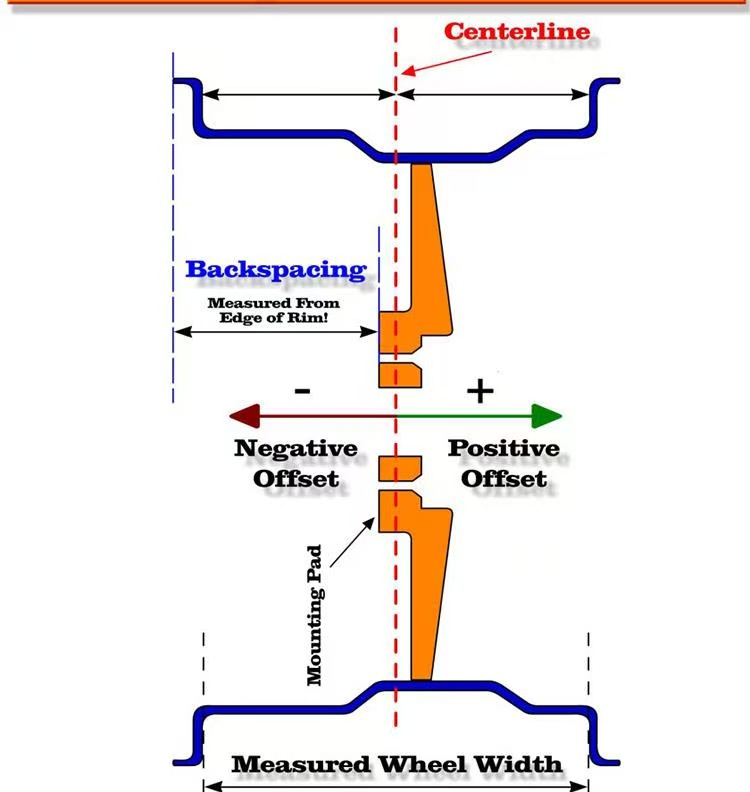
Offset (ET value) refers to the distance in millimeters from the wheel’s mounting surface to its centerline, serving as the core indicator for determining the wheel’s inward and outward position on the vehicle. A positive offset (+ value) positions the mounting surface closer to the rear of the wheel, tucking the wheel toward the inside of the wheel arch; a negative offset (- value) pushes the wheel outward, widening the track to improve cornering stability. Notably, wheel width (J value) directly affects the actual effect of the offset: for example, an 8J (8-inch wide) wheel with a +45mm offset protrudes outward by approximately 12.7mm (1/2 inch) more than a 7J wheel with the same +45mm offset, so it is essential to evaluate the wheel arch clearance in advance.
Backspace is the straight-line distance from the wheel’s mounting surface to its rear edge. A larger Backspace value means the wheel sits deeper inside the wheel arch, preventing interference with suspension components; an excessively small value may cause the wheel to rub against the fender. Essentially, Backspace and Offset describe the wheel’s position from different dimensions and can be converted into each other using formulas.
Core Conversion Formulas (Essential for Precise Customization)
Offset (inches) Conversion Formula
Offset (inches) = (J value × 25.4 ÷ 2 – ET value (mm)) ÷ 25.4
(Note: J value is the standard unit for wheel width, e.g., 7J, 8J; 1 inch = 25.4 millimeters)
ET Value (mm) Conversion Formula
ET value (mm) = (J value × 25.4 ÷ 2) – Offset (inches) × 25.4
Professional tuning technicians remind that when upgrading wheels, a comprehensive verification must be conducted in combination with the original factory parameters, suspension structure and tire size. Blindly pursuing a large negative offset for a “stanced” visual effect may increase the bearing load and shorten the service life of suspension components. It is recommended that enthusiasts first make preliminary calculations using the conversion formulas, then conduct fitment tests with professional tools to strike the perfect balance between visual appeal and driving safety.
A really good blog and me back again.